Showing posts with label fivethirtyeight blog. Show all posts

Monday

Nate Silver on Romney's VP pick

As you know, in election years I like to check in on Nate Silver's blog FiveThirtyEight, (eg here, here, and here) which is consistent, clear, interesting and well written. He's doing a particularly interesting job relating the impact of Romney's pick of Paul Ryan as a running mate. There have been a lot of theories for the pick floating around: Ryan is a Washington insider, he'll bring out the base, he understands the budget issues. (And don't forget to read Samuel Popkin's take on James Fallows' blog, here.)

I'm a numbers person, so I would have gone for someone who I thought might help me in a swing state, like Florida or Ohio. That means someone from a swing state who is popular in the state. Here's Silver's analysis of the likely VP choices as of August 8:
According to Silver, Florida, Ohio and Virginia are in play (as of now); Wisconsin and New Mexico are leaning Democratic. Silver says:
 Five candidates stood out as having especially strong positive ratings with their home-state voters. These were Mr. McDonnell of Virginia, along with Govs. Susana Martinez of New Mexico, Bobby Jindal of Louisiana and Brian Sandoval of Nevada, and Senator John Thune of South Dakota. The ratings for Mr. Christie and Mr. Rubio were also fairly strong.

Another of Mr. Romney’s potential choices, Representative Paul Ryan of Wisconsin, drew more mixed reactions. Although Mr. Ryan should win his home district, pollsters who tested his numbers throughout Wisconsin found more tenuous results, with 38 percent of voters giving him a positive rating and 33 percent a negative one.
Silver's model predicts (remember, this is as of August 8) that the pick of Ryan would increase Romney's chances of winning the Electoral College by 0.1%. That's not much.

You can read Silver's analysis of the bounce Ryan gave the ticket last week here. His bottom line? The bounce was "below-average." But, as Silver points out, the bounce now is not what's important. "If Mr. Romney makes a one-point advancement in the polls and holds it permanently from his selection of Mr. Ryan, then this would count as a successful vice presidential selection: a one-point shift in the polls is actually fairly meaningful given how close this race is."

And today, after giving it some thought, Silver argues that the selection, and the outcome, will give us some insight into the country's longer term political shifts. Read the post - the bottom line in particular is pretty interesting in the context of the full discussion.

Wednesday

Recall vote in Wisconsin as harbinger for the 2012 general election? Not so fast

Governor Scott Walker of Wisconsin survived yesterday's recall vote despite the passion, hard work, and money poured into the recall efforts. Many news organizations are using the vote to discuss the future of organized labor. Others wonder whether the vote sends a signal about improving Republican chances in the November presidential elections.

Nate Silver posted a very good column yesterday analyzing his suggestion that races for governor can sometimes give contrary indicators for presidential elections. Here's what he says:
But one thing that the recall is unlikely to do is tell us much about how the presidential contest in Wisconsin is likely to evolve in November. The politics for a governor’s campaign are often subject to different currents than presidential ones, and historically the party identification of a state’s governor has said little about how presidential candidates will fare there.
Over the past 40 years, in fact, the relationship has run in the reverse direction than you might expect. The Democratic presidential candidate has typically done a little better when the state’s governor is a Republican, and vice versa.
Why is this so? As usual, Silver is clear in his explanations, providing two tables, one showing presidential vote margins by party of state governor, and the other, slightly more refined, showing presidential vote shift by party of state governor. But correlation is not causation, and Silver is always careful to remind readers of that fact. He offers two hypotheses and one caution. One hypothesis is that voters like balance in their elected officials; the other is that some voters tend to vote for the incumbent. The caution is that the aggregated data may hide some factors. This counterintuitive suggestion, backed up by numbers, is an interesting addition to the discussion. Do you agree?

It's an election year! Time to start obsessing about polling

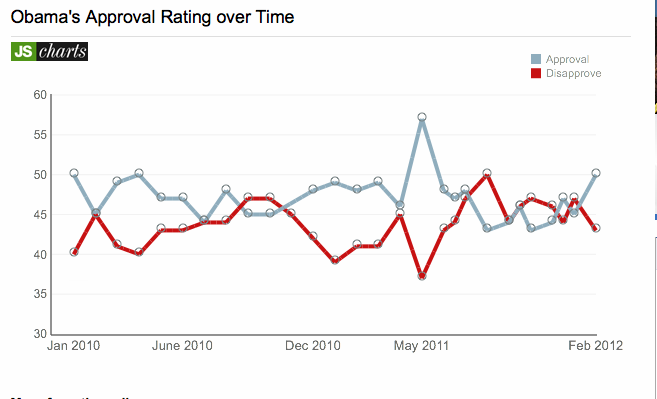
Let's start with Presidential approval ratings.

According to a CBS News poll released yesterday, President Obama's are up, reaching 50% for the first time since May, 2011:


CNN's polls say the same thing. So do Rasmussen Reports, which says that 49% approve of the President, and that 49% disapprove. They display the data differently:

What's going on here? I suspect it's in the way the questions are asked and the data tabulated. If CBS and CNN subtracted the lukewarm approvals from the strong approvals, you might get the 27% strong approvals that Rasmussen reports. But it appears that right now there are more people expressing strong and lukewarm approval than there are expressing disapproval. The takeaway? If you can, look at more than source for information. And think about how each organization is reporting its data. And right now, in a head-to-head competition, even Rasmussen reports that Obama beats Santorum and Romney.

Which is what Nate Silver, of FiveThirtyEight (now a part of the New York Times) reports as well. I should say that's what Silver concludes, as he is using an early stage model taking account of the economy, each candidate's ideology, and the approval ratings. He also has some projections about upcoming Republican primaries (in Arizona, Michigan, Georgia, and Ohio). FiveThirtyEight is a great site, and I'll be keeping an eye on it in the coming months. Even though the election is still nine months away.

Popular Posts