Wednesday

Soda consumption in one graph


Now that New York City's regulations on the sale of large sodas are close to coming into effect, here's a graph showing an interesting convergence: coffee sales and soda sales are coming close, it lease in terms of revenue. (Note that it doesn't show anything about amounts consumed.) It's from Derek Thompson of The Atlantic. He goes on to point out that part of the explanation is that coffee costs more, but another is that we really are starting to substitute water or sports drinks for soda. Read the column - it's a good one. And let me know if you find consumption data anywhere.

Tuesday

Walking more - and measuring it

Here's a new, smaller entry in my self-quantifiers series. Alexis Madrigal, in The Atlantic, has posted a column about his new fitness program: walking. Yes, walking, that famous 10,000 steps per day to fitness, or at least health. According to Madrigal, that's about double the American number of just over 5000 steps per day.

So, how much do you have to walk every day to get up to those 10,000 steps? Ten thousand steps is about five miles (the distance varies with your height and the length of your stride). You don't have to set out to walk five miles to get that number of steps in. But you do have to make an effort to walk places that you might otherwise drive to. In New York City, that's not a problem, but in other places, where there are no sidewalks, it can be.

Madrigal puts it like this:
Americans lag behind the rest of the world in steps taken precisely because we travel so rarely for transportation's sake. Our cities are spread out (NYC excepted) and car culture is everywhere. A Centers for Disease Control study found that almost 40 percent of Americans had not walked for 10 straight minutes in the past week!

Even more interestingly, Gregg Furie of Yale Medical School led a study that showed that less than 25 percent or people walked or biked as a means to get from one place to another for more than 10 straight minutes in a given week. And yet, Furie's study found that people who engaged in "active transportation," as he calls it, had lower BMI, smaller waists, and lower odds of hypertension and diabetes.
I'll give him the last word: "when you have the opportunity to walk as a means to an end, take it."
 

Monday

Worldometers - one cool web site

The image is a screenshot from a website called Live Statistics in the USA. It's related to Worldometers, which provides real time world statistics. There's a screenshot of it, below. Sometimes its fascinating to watch the number of babies born today click up. But there's more to the site than that. There's data transparency. Wondering about that figure of 931 US homicides this year (as of January 22)? If you click on the "Info" button you get this:
[R]ates per 100,000 people are decreasing steadily since 1991, and are now back at the levels of the mid 1960's after being at twice the current rate in the 70's and 80's. Current estimates are based on CDC data.
The CDC link takes you to CDC's Faststats page. As with anything else, you need to do a little thinking: the figure of 931 is a calculation based on the CDC's rate of 5.3 homicides per 100,000 population, 21 or so days into the year.

Here's a screenshot from Worldometers:

Thursday

Yup, it's cold. Here's an explanation

Temperatures in the east have followed those in the rest of the country, dipping, and staying, well below freezing for the past few days. Why is this happening? Well, it is January. But, as Climate Central explains, we are beginning to understand weather (that's as opposed to climate) a little better. And two things have happened: a "sudden stratospheric warming event" is sending arctic air south, while the Madden-Julian Oscillation has shifted to a phase that favors cold air over the eastern US.

Climate Central's Andrew Freedman quotes Michelle L'Heureux, a climate scientist at NOAA, on the Madden Julian Osciallation:
“The MJO is presently located in a position that favors increased tropical rainfall over the central Pacific (and decreased rainfall over the eastern Indian Ocean-Maritime Continent),” L’Heureux said in an email conversation. “This pattern is most significantly linked to more cold air outbreaks over the eastern U.S.”
She added that it may be too early for the sudden stratospheric warming event's effects to be felt - which means more cold weather ahead. You can read more about the "sudden stratospheric warming event" here. And yes, it's climate change related. According to Climate Central, sudden stratospheric warming events take place in about half of Northern Hemisphere winters, and they have been increasing in frequency.

Image via http://www.intellicast.com/National/Temperature/Current.aspx
 

Wednesday

Causation and correlation again

A recurring theme in this blog is that correlation is not causation. Yet it's easy, and tempting, to make the mental leap from correlation to causation without sufficient information. Today's example is this column from Lindsay Abrams in The Atlantic. Titled "When Trees Die, People Die" the column describes a study that appears in the American Journal of Preventive Medicine about the relationship between trees and human health.

Here's how Abrams describes the study:
Within four years of first becoming infested, the ash trees die -- over 100 million since the plague began. In some cases, their death has an immediate impact, as they fall on cars, houses, and people. In the long term, their disappearance means parks and neighborhoods, once tree-lined, are now bare.
Something else, less readily apparent, may have happened as well. When the U.S. Forest Service looked at mortality rates in counties affected by the emerald ash borer, they found increased mortality rates. Specifically, more people were dying of cardiovascular and lower respiratory tract illness -- the first and third most common causes of death in the U.S. As the infestation took over in each of these places, the connection to poor health strengthened.
Note the use of the word "may" in the first sentence of the second paragraph, and the conclusion in the last sentence. But the post overstates the conclusions of the study, which is available here. The authors, having surveyed the literature, conclude that their study strengthens the correlation, but reiterate that they can conclude nothing about causation.

It's the kind of thought-provoking study that should inspire more studies. Let's hope it does.

Tuesday

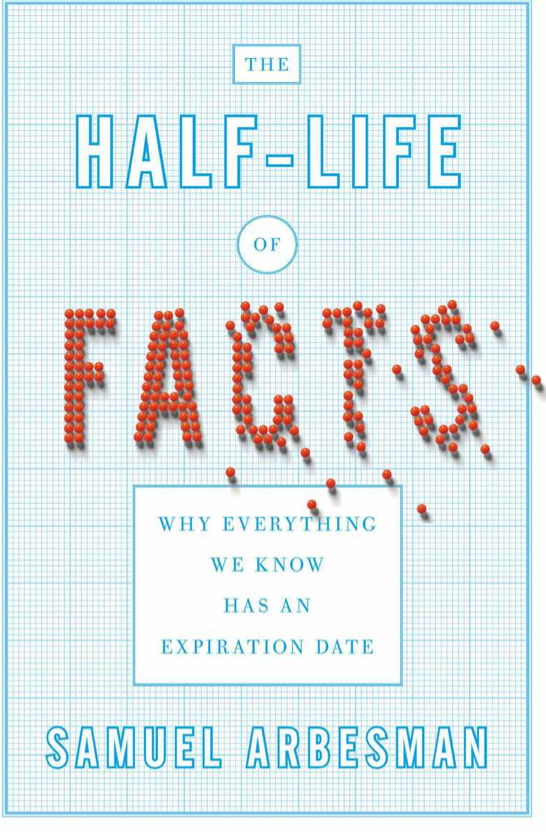
"The Half-Life of Facts," by Samuel Arbesman

In Samuel Arbesman's expression, set out in his new book "The Half-Life of Facts: Why Everything We Know Has an Expiration Date," we dwell in uncertainty. Things around us, things we think we know, are always changing. Sometimes it's because we learn more - many of Arbesman's examples come from our increasing knowledge of dinosaurs (they didn't have feathers or colors, and barely had brains, when I was a kid). Sometimes we get better at measuring - look at what happened to the size of Pluto (it is smaller than we were taught and is now no longer thought to be a planet). The rapid pace of change can feel confusing, if not overwhelming. How can we possibly keep up?

In his clear and well-written book Arbesman tells us how to approach the problem. He demonstrates how knowledge changes in regular ways, ways that are systematic enough for us to understand. He argues that understanding the changes helps us make sense of the world and allows us to prepare for the changes we can anticipate. (I think these are what have been called in another context the known unknowns.) From my blog's perspective, it's a well-written, useful book about the importance of thinking critically.

Arbesman uses the work of John Ioannidis to remind us that one study is never enough, and that we are prone to jumping to conclusions. Just because something has been published doesn't mean that it is true, or will hold up over time. In fact, chances are, it won't. (As in most other statistical situations, that means the aggregate of papers, because you can't at any particular time tell which ones will last.) Replication is the best way to test scientific findings, but replicating someone else's work doesn't mean prizes or even necessarily publication. Here are a few common-sense corollaries that Arbesman provides to keep in mind when you read or hear about new studies:
  • The smaller the studies conducted in a scientific field, the less likely the research findings are to be true.
  • The smaller the effect sizes in a scientific field, the less likely the research findings are to be true.
  • The greater the number and the lesser the selection of tested relationships in a scientific field, the less likely the research findings are to be true.
  • The greater the flexibility in designs, definitions, outcomes, and analytical modes in a scientific field, the less likely the research findings are to be true.
  • The greater the financial and other interests and prejudices in a scientific field, the less likely the research findings are to be true.
  • The hotter a scientific field (with more scientific teams involved) the less likely the research findings are to be true.
It's equally important to think critically about the smaller things in our lives too. We communicate through networks, of both the interpersonal and the electronic kind. Unfortunately, we also transmit errors that way. Errors, Arbesman tells us, often spread more slowly than truths, but they also linger. His solution is one well worth adopting: be critical before you push send or post or otherwise share that scary story. (He reminds us that there are a couple of websites that provide the research, including snopes.com and xkcd.com, so that we don't have to worry about debunking each myth that comes our way.)
There's a lot more going on in this entertaining and interesting book. If you think, as I did, that the title is a metaphor, well, nope. Growth in human knowledge is exponential, though different fields have different rates of increase. New discoveries prove old ones wrong, and what we know changes. There are a couple of concomitants to this information. First, it's getting harder to make discoveries (though contiguity with one's collaborators makes everyone's work better.) Second, over time, most scientific papers will be superseded or shown to be wrong. The turnover is true for central tenets as well as for details.

You may have heard of Moore's Law, the one that says that the capacity of a computer chip doubles every 12-18 months. In a chapter titled "Moore's Law of  Everything" Arbesman generalizes that tenet to growth in many areas. The interplay between science (what we know) and technology (what we can do) depends on the growth of knowledge. But it also depends on the growth of the human population: more population means more knowledge. Of course, he adds, the people need to be interested in and able to become scientists and engineers, and we need to be able to communicate what we have learned. Sometimes knowledge in one field stays hidden from experts in another, but we are beginning to understand the mechanisms that allow the systematic exploitation of one area's learning in another. We often study what interests us, what we like, or what’s easier to discover. And cognitive biases can interfere with our ability to understand what is right under our noses.

This is not a book of philosophy or statistics but a very good effort at making some useful work accessible. Do you agree? Let me know what you think in the comments.

Monday

Global warming - 62 years in 13 seconds

From NASA via Climate Central, this video shows how the pace of global warming is accelerating. Watch closely, Climate Central says:
You’ll note an acceleration of the temperature trend in the late 1970s as greenhouse gas emissions from energy production increased worldwide and clean air laws reduced emissions of pollutants that had a cooling effect on the climate, and thus were masking some of the global warming signal.

Popular Posts